 0208 3517 101


An Office Relocation Case Study With Zero Downtime
This office relocation case study shows how careful planning, IT migration and phased delivery protect productivity through a complex business move safely.
Call us on 0208 3517 101
 ISO 9001 & 14001
Certified
 4.9
Trustpilot
 5.0
Google Reviews
 195+
Trees Planted
 25+ Years
Experience
A business move is only successful when people can work as planned on the first working day. This office relocation case study follows a typical high-stakes London move: a growing professional services firm leaving a serviced office for a larger, fitted workplace while keeping client service, secure systems and staff productivity protected.
The example is anonymised, but the operational challenges are familiar to office managers, facilities teams and IT leads. The business had 85 employees, a mixture of desk-based and hybrid workers, a secure server cabinet, meeting-room technology, confidential files, and a fixed handover date on its existing premises. There was little tolerance for disruption. Monday morning needed to look and feel like business as usual.
The brief: relocate without interrupting operations
The client’s new office was ready for occupation, but not yet ready for work. Furniture needed installing, technology had to be positioned correctly, labelled assets had to reach the right departments, and redundant items needed removing from the old site. The move also had to comply with the building management rules at both locations, including lift bookings, loading-bay access and restricted working hours.
The central risk was not simply getting items from A to B. It was coordinating several dependent activities in the right sequence. If IT equipment arrived before desks were installed, the technical team could not complete workstation setup. If archive files were moved without an inventory, staff could lose access to essential records. If clearance was left until the final day, the outgoing office could fail its handover inspection.
Rather than appointing separate firms for removals, IT relocation, furniture installation and disposal, the client required one accountable project partner. SolutionsX assigned a dedicated Project Manager to build the move plan, coordinate stakeholders and remain the single point of contact from survey through to post-move support.
Office relocation case study: the planning phase
The project began with a detailed site survey at both offices. This was not a box-counting exercise. The survey established access routes, lift dimensions, floor protection requirements, parking restrictions, loading arrangements and the equipment that needed specialist handling. It also identified items that would move, go into storage, be donated where suitable, or be cleared through responsible disposal routes.
The Project Manager then produced a move schedule around the client’s operational needs. Core teams would work remotely on the Friday afternoon, allowing packing and pre-move preparation to begin before the main relocation weekend. The customer-facing team retained access to its cloud systems throughout, while the IT team maintained responsibility for the final shutdown and restart of critical equipment.
A colour-coded labelling system linked every crate, workstation and item of furniture to a floor, department and final desk position. This matters more than many businesses expect. A clearly labelled move prevents the Monday morning scramble where staff search for monitors, files or personal equipment across an unfamiliar office.
The plan also included a communications timetable. Staff received packing instructions, deadlines for personal belongings, guidance on confidential paperwork and a clear outline of what would be available on arrival. Building managers received risk assessments, insurance details and delivery schedules in advance. These practical steps reduced uncertainty before a lorry arrived on site.
Managing IT, furniture and secure assets
IT migration was treated as a controlled workstream, not as an add-on to the removal. The client’s IT lead and relocation team agreed an asset list covering servers, network hardware, screens, docking stations, printers and meeting-room equipment. Specialist packing materials and anti-static protection were used where required, while equipment was recorded before loading and checked again at delivery.
The server cabinet required particular care. Its shutdown window was agreed in advance, the equipment was securely packed and transported, and the destination location had been checked for power, access and rack readiness. The client’s own IT team completed reconnection and testing, while the relocation crew positioned equipment in the planned sequence. This division of responsibility avoided confusion and maintained control of technical sign-off.
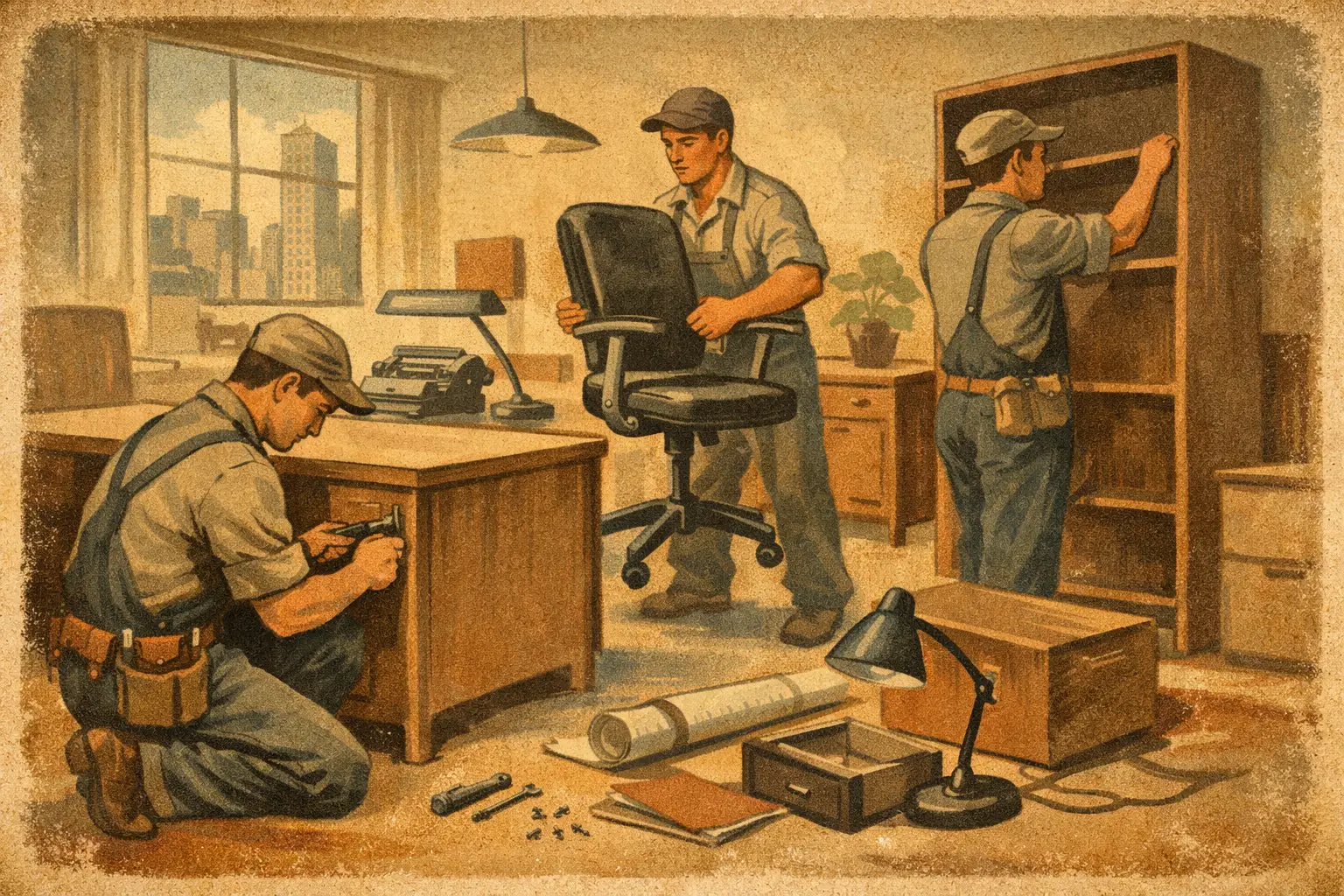
Furniture installation was planned around the workplace layout rather than the fastest unloading route. Desks, task chairs, storage units and meeting tables were delivered to their final locations, assembled where needed and checked against the floor plan. Staff did not arrive to a room full of unallocated boxes. They arrived to a usable workspace.
Confidential records were packed into secure, labelled crates and tracked through the move. Surplus filing, damaged furniture and unwanted equipment were separated early, preventing unnecessary transport costs and reducing clutter at the new premises. Responsible clearance also supported the client’s environmental objectives and simplified the dilapidation process at the old office.
Delivery weekend: sequence protected the outcome
The physical move took place over a weekend, with timed access agreed for both buildings. The crew protected floors and key transit routes before work started. Furniture installation at the new office began before the final workstation delivery, allowing desks to be prepared for IT equipment as it arrived.
At the outgoing office, teams worked zone by zone. Each area was checked against the inventory before loading, which helped prevent small but disruptive losses such as adapters, desk pedestals and labelled file crates. At the destination, the same labels directed goods to the correct floor and department without waiting for client staff to make decisions on the spot.
The Project Manager monitored progress against the schedule, dealt with building-management queries and confirmed completion of each stage. This is where project-led delivery makes a practical difference. A move rarely follows the original timetable perfectly. A delayed lift, a change to loading-bay access or an unexpected item can affect the plan. One person with authority to reallocate resources and communicate clearly prevents minor issues becoming operational delays.
By Sunday evening, workstations were in place, meeting rooms were furnished, IT equipment had been positioned for final testing, and the old office had been cleared to the agreed scope. The client’s IT team completed system checks before staff returned.
The result: a working office on Monday morning
The business opened from its new location on Monday with employees able to access their workstations, team areas and meeting spaces. Client-facing activity continued without a planned closure, and the outgoing premises were ready for handover.
The strongest result was not a dramatic removal-day statistic. It was the absence of avoidable disruption. No department was left searching for essential equipment. No critical IT asset was unaccounted for. No senior manager had to spend the weekend coordinating separate suppliers. The move was managed as a business continuity project, not merely a transport job.
That said, zero downtime depends on the nature of the organisation. A business with on-site servers, regulated records, laboratory equipment or a 24-hour operation may require phased moves, temporary infrastructure or extended testing windows. The right approach should follow the operational risk, not a standard removal template.
What this case study means for your move
A well-run office relocation starts with the question: what cannot stop working? Once that is clear, every decision can support it, from the move date and packing plan to IT sequencing, furniture installation and final clearance.
For organisations moving within London, across the UK or internationally, early planning creates options. It allows time to survey both sites, reserve building access, brief employees, separate redundant assets and coordinate technology properly. Leaving these decisions until the final week usually increases cost, pressure and risk.
The most useful next step is to map your critical operations and appoint a relocation partner that can take ownership of the entire programme. When planning, logistics, IT handling, installation, storage and disposal work to one schedule, your new office can be ready for the people who make it work.


Get Your Free Quote Today
Fill out the form below and our team will respond within 2 hours
Reach out and we’ll
get back to you shortly.


12 Jenner Avenue Acton,
W3 6EQ London

Saturday: 9:00am – 2:00pm
Sunday: Closed