 0208 3517 101
Office Furniture Installation Services Explained
Office furniture installation services help businesses set up faster, safer and with less disruption during relocations, refits and workplace changes.
Call us on 0208 3517 101
 ISO 9001 & 14001
Certified
ISO 9001 & 14001
Certified 4.9
Trustpilot
4.9
Trustpilot 5.0
Google Reviews
5.0
Google Reviews 195+
Trees Planted
195+
Trees Planted 25+ Years
Experience
25+ Years
ExperienceA new office layout rarely fails because the desks were late. It usually fails because nobody owned the final setup. Deliveries arrive in stages, access times tighten, IT needs certain positions, and staff are due back at 8.30 on Monday. That is where office furniture installation services make a measurable difference. They turn a pile of components, floorplans and deadlines into a working environment that is ready for use.
For facilities teams, office managers and project leads, the real value is not simply assembly. It is control. A properly managed installation reduces disruption, protects assets, supports health and safety obligations, and keeps the wider move programme on track. If furniture delivery, removals, storage, clearance and IT setup are all happening around the same time, poor coordination can create avoidable downtime very quickly.
What office furniture installation services actually cover
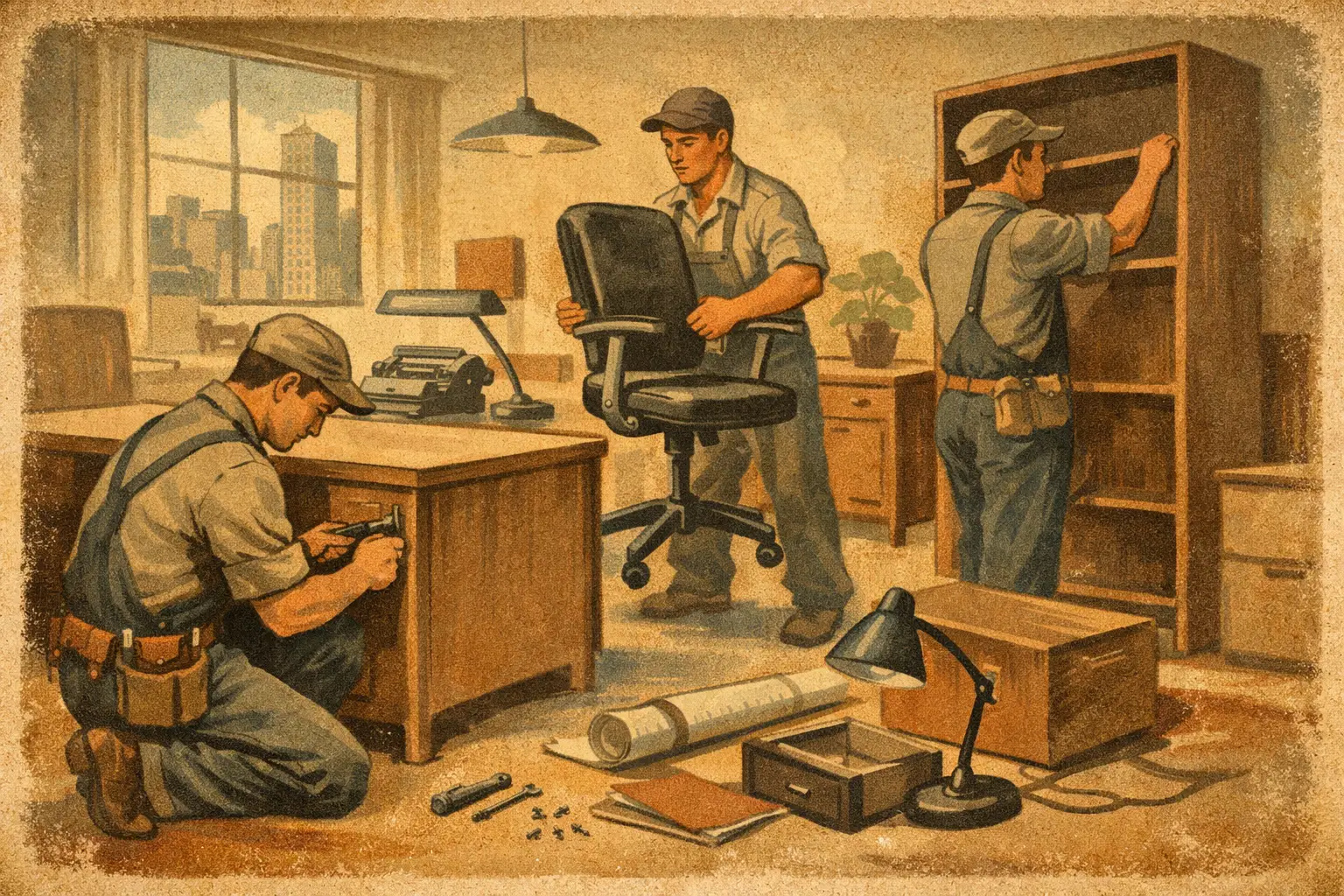
At a practical level, office furniture installation services include receiving, positioning, assembling and adjusting workplace furniture so it matches the agreed plan. That can mean bench desking, executive furniture, boardroom tables, reception counters, meeting booths, lockers, filing systems and breakout furniture. In many projects, it also includes disassembly at the old site, careful labelling, transport coordination and reinstallation at the new premises.
The scope depends on the business and the building. A straightforward installation in a small office may only require desks, chairs and storage units to be assembled and placed correctly. A larger corporate relocation usually involves phased works, floor-by-floor sequencing, lift bookings, out-of-hours access, waste removal and close coordination with IT engineers, decorators and building management.
This is why experienced providers treat installation as part of workplace logistics rather than a standalone task. Furniture has to arrive in the right order, in the right condition, and be fitted according to the live project schedule. If one stage slips, the impact travels quickly across the move.
Why office furniture installation services matter in live business environments
The main risk in any office move or refurbishment is interruption to normal operations. Staff cannot work effectively in a half-built environment, and managers should not be chasing missing parts, unclear floorplans or unresolved snagging while trying to keep the business running.
Professional installation reduces that pressure in several ways. First, it creates accountability. One team is responsible for reading the layout, allocating labour, handling tools and fixings, and completing the fit-out to specification. Second, it improves safety. Incorrect assembly, unstable storage units or poorly positioned workstations can create immediate risk. Third, it shortens the time between delivery and occupation, which matters when leases, landlords and internal deadlines are all in play.
There is also a commercial point that is often missed. Downtime is expensive, but so is partial readiness. If your sales team is back in the office but meeting rooms are unusable, or your operations team has desks but no configured workstation layout, the business is technically open and still losing productivity.
What a reliable installation process should look like
A dependable provider starts before any furniture is touched. Site surveys, access checks and programme planning are essential, especially in London buildings with restricted loading bays, shared lifts and strict contractor windows. The installation team should understand not just what is being fitted, but when each area needs to be handed over for use.
Survey, planning and sequencing
The planning stage should confirm quantities, furniture types, floorplans, phasing requirements and access constraints. This is also the point where businesses can identify dependencies. For example, desking may need to be installed before IT can cable and commission workstations, while storage walls may need to wait until final partition measurements are checked.
Good sequencing prevents rework. It also helps avoid a common problem in office projects – too many trades occupying the same space at once.
Delivery coordination and on-site handling
Furniture installation only works if product flow is controlled properly. Items should be checked against manifests, moved safely into the building and staged in a way that supports efficient assembly. In occupied offices or multi-tenant buildings, this has to be done with minimal disturbance to staff and neighbouring businesses.
Packaging removal matters here as well. Large volumes of cardboard, plastic and pallets can quickly obstruct routes and create unnecessary hazards if they are not cleared as the work progresses.
Assembly, placement and final adjustments
Once assembled, furniture should be positioned accurately to the agreed layout rather than placed approximately and left for staff to correct later. That includes desk spacing, ergonomic setup, meeting room alignment and storage placement. Small errors at this stage often become larger operational irritations once teams move in.
Final adjustments and snagging should be part of the service, not an afterthought. If a pedestal catches, a worktop needs levelling or a bank of desks sits slightly out of line, those issues should be resolved before handover.
Choosing office furniture installation services for a relocation or refit
Not every provider is equipped for commercial projects. Some can assemble furniture competently but are not structured to manage building access, programme pressure or multi-service coordination. For a business move, that distinction matters.
Look for a provider with experience in live office environments, clear project ownership and the ability to work alongside removals, storage, IT relocation and clearance teams. If you need several moving parts handled together, using separate suppliers can create gaps in responsibility. One contractor blames delayed access, another blames late deliveries, and the client is left resolving the problem.
This is why many businesses prefer a complete-service partner. When one provider manages the broader move programme, installation becomes part of a controlled process rather than an isolated trade package. For organisations with tight timelines or zero-downtime requirements, that joined-up approach is usually the safer option.
Accreditations and operating standards are worth checking too. Commercial clients need confidence around process discipline, environmental handling and service consistency. A provider such as SolutionsX, with project-led delivery and recognised ISO standards, signals a more dependable framework for complex workplace change.
Common challenges and where things can go wrong
Furniture installation sounds straightforward until the constraints become real. The wrong lift dimensions, incomplete inventory, damaged components or an outdated floorplan can stop progress fast. In some cases, the issue is not the furniture itself but poor communication between the landlord, fit-out team, removals provider and internal stakeholders.
There are also trade-offs. Out-of-hours installation can reduce disruption to staff, but it may increase cost. Reusing existing furniture can support budgets and sustainability goals, but older items may take longer to dismantle, transport and reassemble. Phased occupation can keep departments operational, but it requires tighter sequencing and clearer zone control.
The right provider should be honest about those variables. A professional plan does not pretend every move is identical. It identifies pressure points early and builds contingencies around them.
When a managed service delivers the best result
If your business is moving a small number of desks within one floor, a basic installation team may be enough. But if the project includes office removals, IT equipment, storage, disposal, or multiple departments relocating at once, managed delivery becomes far more valuable.
A dedicated project manager can coordinate surveys, schedules, labour, transport and handover across the whole programme. That reduces the burden on internal teams and gives decision-makers one point of accountability. It also helps maintain momentum when changes happen, which they often do.
For procurement and operations leads, this comes down to risk control. The cheapest line item is not always the lowest-cost outcome if delays, rework or lost trading time follow.
The business case for getting it right first time
Office furniture is visible, but its installation affects much more than appearance. It shapes how quickly teams can return to work, how safely the space functions, and how confidently a move is delivered. A well-executed setup supports staff experience from day one. A poor one creates complaints, fixes and lost time before the first full week is over.
That is why office furniture installation services should be treated as an operational service, not an afterthought. When planned properly, they protect continuity, support compliance and remove pressure from the people already carrying the wider move.
If your next workplace change has more moving parts than your internal team can reasonably control, the right installation partner will not just build furniture. They will help you open the doors on time, with the office ready to work.

Get Your Free Quote Today
Fill out the form below and our team will respond within 2 hours
Reach out and we’ll
get back to you shortly.


12 Jenner Avenue Acton,
W3 6EQ London

Saturday: 9:00am – 2:00pm
Sunday: Closed