 0208 3517 101
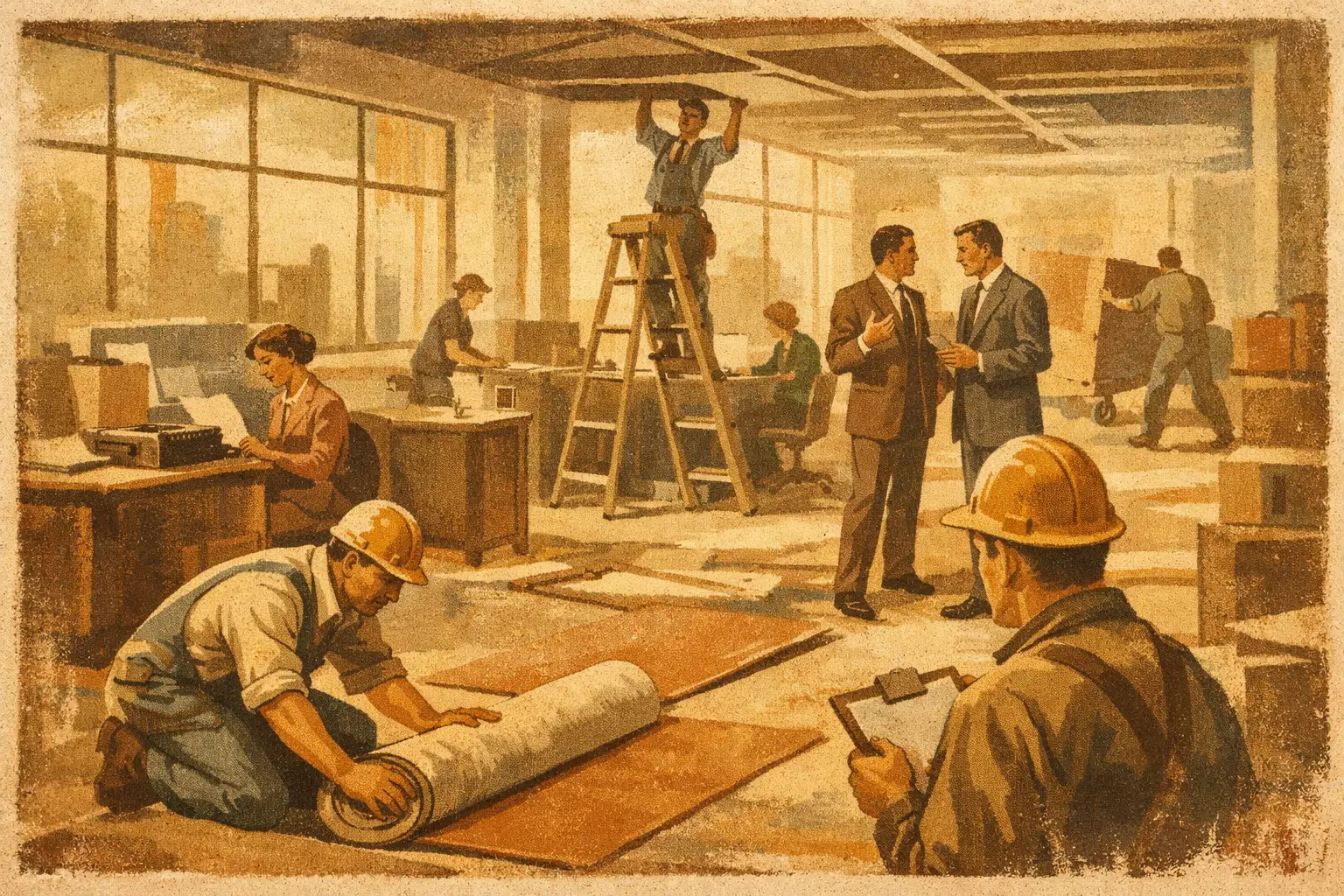
Office Fit Out Support That Cuts Disruption
Office fit out support helps businesses deliver new workplaces with less disruption, tighter control, and better coordination across move, IT, and setup.
Call us on 0208 3517 101
 ISO 9001 & 14001
Certified
ISO 9001 & 14001
Certified 4.9
Trustpilot
4.9
Trustpilot 5.0
Google Reviews
5.0
Google Reviews 195+
Trees Planted
195+
Trees Planted 25+ Years
Experience
25+ Years
ExperienceA fit-out rarely fails because the design was wrong. It fails because too many moving parts were left to too many different suppliers, with no one taking responsibility for how the space actually becomes operational. That is where office fit out support matters. For facilities teams, office managers and operations leads, the real challenge is not choosing finishes or furniture. It is making sure people, equipment, infrastructure and timelines all line up without interrupting the business.
The term gets used loosely, so it is worth being clear about what it should mean in practice. Proper office fit out support is not just labour on moving day or a team to build desks. It is coordinated delivery across planning, logistics, furniture installation, IT migration, storage, clearance and final workplace setup. If one part slips, the whole programme feels it. If those parts are managed together, the move into a new or refurbished office becomes far more controlled.
What office fit out support should cover
Most businesses do not need another supplier to add to the list. They need a delivery partner that can take control of the practical work around the fit-out and keep the programme moving. That starts before anyone lifts a crate.
At the planning stage, support should include site surveys, access checks, scheduling, move phasing and risk assessment. In occupied buildings, these details are not minor. Lift bookings, loading restrictions, landlord requirements and out-of-hours access can change the entire delivery plan. If they are not addressed early, delays show up later when they are hardest to absorb.
Once the programme is live, office fit out support should extend to packing, asset handling, furniture breakdown and reinstallation, IT and server relocation, storage for phased works, and responsible clearance of unwanted items. For many organisations, there is also a decant element. Teams may need to move temporarily while one part of the office is completed, then return in stages. That takes more than transport. It takes sequencing.
The final piece is workplace readiness. A space is not ready because the flooring is down and the desks are in. It is ready when teams can arrive and work. That means workstations positioned correctly, IT reconnected, meeting areas equipped, storage placed, crates removed and snagging dealt with quickly. The closer support gets to that outcome, the more value it adds.
Why office fit out support reduces project risk
Fit-outs create pressure across several departments at once. Facilities may own the building side. IT is focused on infrastructure and uptime. Operations wants business continuity. Procurement wants cost control. Senior leadership wants a fixed date and no surprises. Without joined-up support, those priorities can pull in different directions.
The main benefit of experienced office fit out support is that it reduces operational risk at the interfaces. These are the points where projects usually become messy – when furniture arrives before space is ready, when staff move plans do not match IT cutover, or when clearance and installation teams are booked with no regard for one another.
A good delivery model closes those gaps. It gives the business one practical programme rather than several overlapping ones. It also creates accountability. If a single partner is managing removals, installations, storage and workplace setup, there is less room for confusion over who is responsible for what.
That does not mean one provider should do every specialist task in-house. In some projects, specialist contractors will still handle specific fit-out works. The point is coordination. A dependable support partner understands how their work fits around principal contractors, designers, building managers and internal stakeholders. That is often the difference between a smooth handover and a rushed first day in a half-ready office.
The stages where support makes the biggest difference
The earliest stage is usually where the biggest savings are made. When office fit out support is brought in late, the team is often reacting to a fixed programme rather than shaping it. That can still work, but options are narrower. Early involvement allows time to assess logistics, identify constraints and build realistic move phases.
During enabling works and decants, support becomes even more important. Businesses often underestimate how disruptive temporary moves can be. Staff need clear labelling, equipment needs tracking, and departments need to know where they are going and when. If those details are vague, productivity drops quickly.
Installation and reinstatement are another pressure point. Furniture may need to be assembled in sequence across several floors or zones. Existing furniture might need adapting to a new layout. Deliveries need to be timed so corridors and loading areas do not become congested. There is no single formula here. A small office refresh and a multi-floor corporate fit-out need very different planning.
The final move-in phase is where pressure peaks. Deadlines are fixed, senior stakeholders are watching, and tolerance for disruption is low. This is where dedicated project management pays for itself. A single point of contact who can manage labour, transport, access, IT coordination and last-minute changes gives the client control when the timetable tightens.
What to look for in an office fit out support partner
Experience in commercial environments matters more than general removals capability. Office fit out support sits at the intersection of logistics, workplace operations and project delivery. The partner you appoint should understand business-critical equipment, chain of custody, phased occupation and compliance requirements as standard.
Project management should be visible from the start. If the quote is little more than a transport price, that is a warning sign. Complex fit-outs need method statements, scheduling, communication plans and contingency thinking. You are not only buying labour. You are buying control.
It is also worth checking whether the provider can cover adjacent services without bringing in several third parties. Storage, furniture installation, secure disposal, packing support and IT relocation often sit within the same programme. Managing those elements under one roof can reduce handover points and make the schedule easier to maintain.
Certifications and process standards matter too, especially for larger organisations or regulated sectors. Quality management and environmental standards show that a provider works to defined procedures rather than improvising on site. That does not guarantee a good result on its own, but it is a strong indicator of operational discipline.
Where projects go wrong
The most common issue is underestimating the operational side of the fit-out. Teams focus heavily on design and construction, then treat the move and setup as a final task to be arranged near completion. By that point, there is little room to absorb changes.
Another recurring problem is fragmented supplier management. One contractor handles furniture, another handles removals, another handles storage, and internal teams are left to connect the pieces. That may look cost-effective at first, but it often creates delays and duplicated effort.
Timing is another factor. Not every business can move over a weekend and be live on Monday. Some require phased relocation, after-hours working or split-site operation during the transition. Office fit out support needs to reflect that reality. A low-cost plan that assumes ideal conditions is not necessarily the most economical once disruption is factored in.
There is also the question of change. Scope shifts happen. Headcount moves, layouts evolve, delivery dates slip. Good support does not pretend that projects stay fixed. It builds in enough structure to adapt without losing control.
A practical approach to office fit out support
For most businesses, the best approach is to treat support as part of workplace delivery, not as an add-on at the end. Bring the operational team in early, define what “ready for occupation” actually means, and map backwards from that point. That should include who is moving, what is moving, what is being installed, what is being stored, and what must be live from day one.
It also helps to separate nice-to-have outcomes from non-negotiables. If a boardroom can be completed on day two, that may be acceptable. If the trading floor, client service desk or core server environment cannot tolerate downtime, that needs protecting from the outset. Not every area of the workplace carries the same level of risk.
This is where a provider with end-to-end capability can make a measurable difference. SolutionsX supports businesses through relocations, IT moves, furniture installation, storage, clearance and workplace setup as part of one coordinated programme. For clients managing a fit-out alongside day-to-day operations, that reduces the burden on internal teams and helps keep the office usable when the pressure is highest.
The right support does not make a fit-out simple. These projects are rarely simple. What it does is make the process controlled, accountable and far less disruptive than it would be otherwise. When the office opens and teams can sit down, log in and carry on working, that is not luck. It is the result of careful planning and proper execution.
If you are planning a workplace change, the key question is not just who can move the contents. It is who can help turn a finished space into a working office without putting the business on hold.
More News From Us
Get Your Free Quote Today
Fill out the form below and our team will respond within 2 hours
Reach out and we’ll
get back to you shortly.


12 Jenner Avenue Acton,
W3 6EQ London

Saturday: 9:00am – 2:00pm
Sunday: Closed