 0208 3517 101
Office Removals vs In-House Moving: Which Works?
Compare office removals vs in-house moving to protect productivity, manage IT risk and choose the right route for your next workplace change in London.
Call us on 0208 3517 101
 ISO 9001 & 14001
Certified
ISO 9001 & 14001
Certified 4.9
Trustpilot
4.9
Trustpilot 5.0
Google Reviews
5.0
Google Reviews 195+
Trees Planted
195+
Trees Planted 25+ Years
Experience
25+ Years
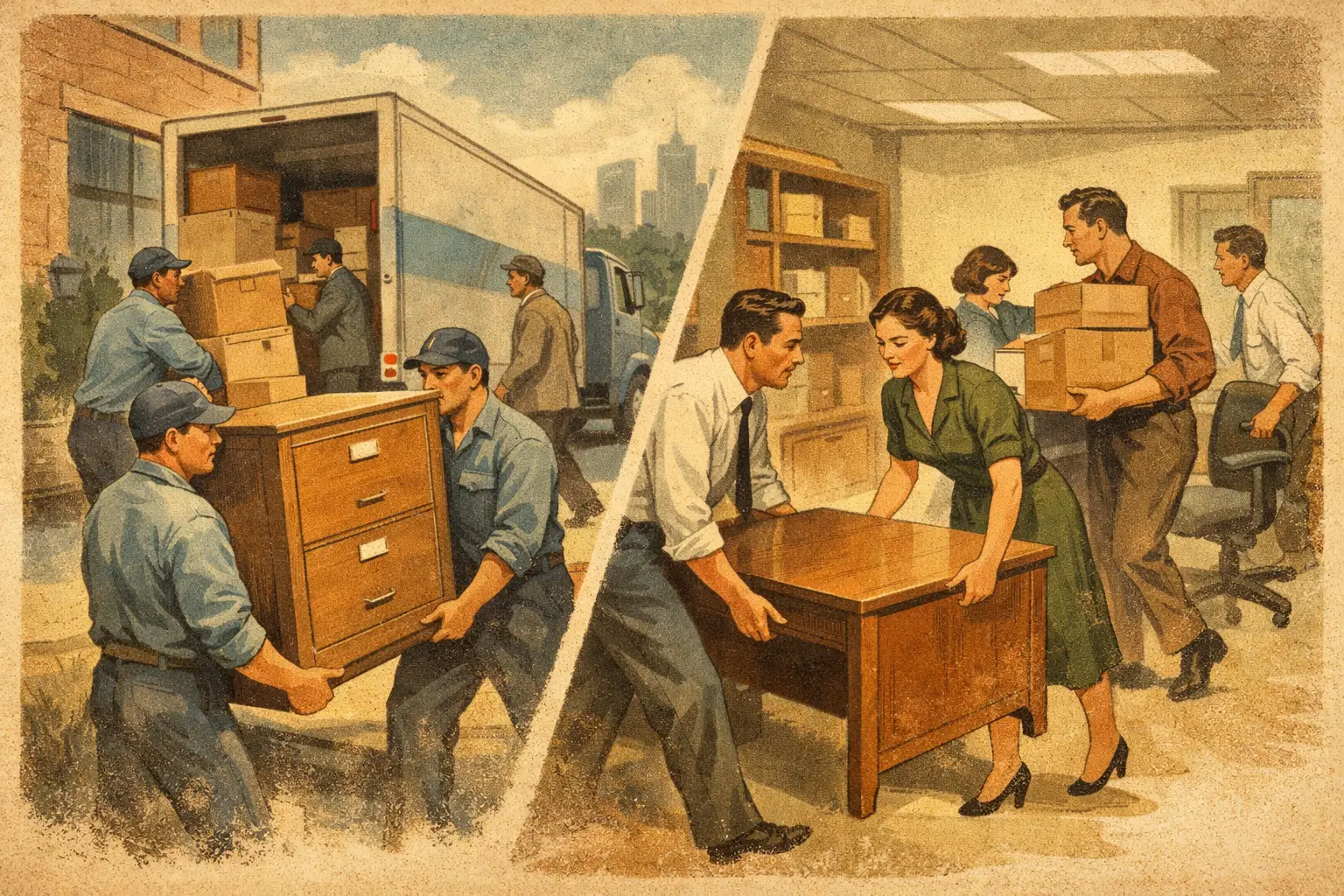
ExperienceA move from one floor to another can disrupt a business just as quickly as a move across London. The choice between office removals vs in-house moving is not simply about distance or transport. It is about who owns the risk, how much operational pressure your team can absorb, and whether staff can continue working while the workplace changes around them.
For a small, low-risk reshuffle, an internal team may be the right answer. For a larger move involving IT equipment, confidential records, furniture, multiple departments or tight deadlines, a managed commercial removals service gives the project the control it needs. The right route depends on the scale, complexity and consequences of getting it wrong.
What counts as in-house moving?
In-house moving usually means relocating people, furniture or equipment within the same building, business park or campus. It may involve a departmental restack, a temporary decant during refurbishment, or moving teams into newly fitted-out space.
Many organisations ask facilities or office management teams to coordinate this work. Staff may pack their own desks, porters may move boxed items, and IT teams may reconnect workstations once the furniture is in place. This can work well where the move is limited, the layout is straightforward and there is enough internal resource available.
However, an internal move still requires a plan. Desks must be labelled, access routes protected, lift bookings managed and staff given clear instructions. If the move affects network cabinets, meeting-room technology, printers or specialist equipment, the project can quickly become more technical than it first appeared.
What is included in professional office removals?
Professional office removals are designed for business moves where continuity matters. The service can cover detailed move planning, crate hire, packing, furniture dismantling, transport, IT and server relocation, installation, storage, clearance and responsible disposal.
A dedicated project manager coordinates the schedule, site access, labour, vehicles and handover. This creates one accountable point of contact rather than leaving an office manager to chase several suppliers while also keeping the business running.
An office removals team also brings the equipment and handling methods needed for commercial environments. This includes trained porters, protective materials, appropriate vehicles, asset tracking and processes for moving sensitive equipment. For businesses handling client data, regulated records or valuable technology, that additional control is often essential.
Office removals vs in-house moving: the real differences
The main difference is not whether items travel one mile or one hundred. It is the level of project management, specialist handling and risk control built into the move.
Control of downtime
In-house moves can appear cost-effective because the business already employs the people involved. But internal teams still have competing responsibilities. An IT manager asked to disconnect and reinstall 80 workstations is not available to deal with service issues, security requests or an unexpected network fault.
A commercial removals provider plans the work around operational requirements. Moves can be scheduled outside core hours, completed in phases, or delivered over a weekend so staff return to a functioning workplace. The objective is to protect productive time, not merely transfer furniture.
IT, servers and data security
IT is often the deciding factor. Moving monitors and docking stations may be manageable for a small team, provided every item is labelled and tested. Moving servers, comms cabinets, network infrastructure and business-critical devices requires a more disciplined process.
A poorly planned disconnect can cause extended downtime, misplaced cables, damaged hardware or configuration problems that only appear on the first working day. There is also the issue of data security. Devices, archived records and confidential paperwork need a documented chain of custody throughout the move.
Where IT is business-critical, involve technical leads early and appoint one person to approve the sequence for shutdown, transport, reconnection and testing. A professional provider can work alongside your IT team, taking care of physical relocation while your specialists retain control of the technology environment.
Health, safety and building compliance
Internal moves are often treated as routine tasks, yet they carry the same practical risks as external removals. Heavy desks, filing cabinets, glass partitions and loaded crates can injure staff or damage lifts, walls and flooring. Busy office corridors also create hazards for employees, visitors and contractors.
Commercial removals teams work to agreed method statements, site rules and access restrictions. They can coordinate loading bays, lift protection, security passes and out-of-hours access with building management. For occupied buildings, this reduces disruption to neighbouring tenants as well as your own workforce.
Capacity and accountability
An in-house team may know the building better than anyone. That local knowledge is valuable, particularly for a modest move with few dependencies. The issue is capacity. If the project expands, who arranges additional labour, packing materials, storage, clearance and transport? Who resolves a delay when a lift is unavailable or a department is not ready?
With an office removals partner, the scope, responsibilities and timetable are defined before work begins. This makes costs easier to understand and gives decision-makers a clear escalation route if the plan changes.
When in-house moving is the sensible choice
Not every workplace change requires a full removals project. In-house moving is often appropriate where the move is contained and the business can accept a degree of internal disruption.
It is a sensible option when only a small team is changing location, furniture remains largely in place, no server or specialist equipment is involved, and the work can be completed without affecting customer service. It may also suit an early-stage space trial, such as moving a project team nearer to a department it works with regularly.
Even then, apply basic controls. Create a seating plan before moving day, label every desk position and crate, confirm who is responsible for IT reconnection, and check the building’s requirements for lift and corridor use. A short written plan prevents the familiar Monday-morning scramble for missing chairs, monitors and power leads.
When professional office removals are the safer route
A managed service becomes the stronger option once the move has multiple moving parts. This is particularly true for office relocations between buildings, large-scale internal restacks, refurbishment decants and multi-site changes.
Consider professional support if your move includes any of the following:
- More than one department or a significant number of workstations
- Servers, network equipment, audio-visual systems or specialist assets
- Confidential files, regulated materials or high-value equipment
- Tight deadlines, weekend working or a requirement to keep teams operational
- Furniture installation, storage, clearance or disposal alongside the move
These are not just logistics tasks. They are dependencies that need sequencing. A new floor cannot open if the desks arrive before power is live, or if staff have no access to their systems. Good project management identifies those dependencies before they become delays.
A practical way to make the decision
Start with the operational outcome, not the removal quote. Ask what must be working on the first day after the move. For some organisations, that means every employee has a desk, monitor and live connection by 9am. For others, it means a customer-facing team, trading floor or service desk cannot lose access at any point.
Then assess the move against four questions: How critical is the IT environment? How much internal resource is genuinely available? What are the safety, security and compliance requirements? What is the cost of downtime if the plan slips?
The answer may be a hybrid approach. Your facilities team can lead staff communications and seating plans, while a removals specialist manages crates, furniture, transport, technical handling and installation. This keeps internal knowledge close to the project without placing the entire operational burden on one team.
Plan the move before the workplace is ready
The most effective moves begin while the new space is still being prepared. Confirm floorplans, power and data readiness, access hours, lift capacity, parking restrictions and handover dates before booking labour. If furniture is being reused, inspect it early so damaged or unsuitable items do not reach the new office by accident.
Staff communication should be practical rather than vague. Tell people when to pack, what they can take, how labels work, where they will sit and who to contact with exceptions. Department leads should validate the final plan, especially where teams share equipment, storage or meeting-room technology.
SolutionsX manages these details through a project-led approach, helping businesses coordinate office removals, IT relocation, installation, storage and clearance under one plan. That level of coordination is particularly useful where a workplace change must be completed without distracting internal teams from their day-to-day responsibilities.
The best choice is the one that keeps your business working. If an in-house move has limited scope and clear ownership, it can be efficient. If the move places productivity, technology or compliance at risk, bring in the specialist support early enough to make the change controlled rather than disruptive.


Get Your Free Quote Today
Fill out the form below and our team will respond within 2 hours
Reach out and we’ll
get back to you shortly.


12 Jenner Avenue Acton,
W3 6EQ London

Saturday: 9:00am – 2:00pm
Sunday: Closed