 0208 3517 101
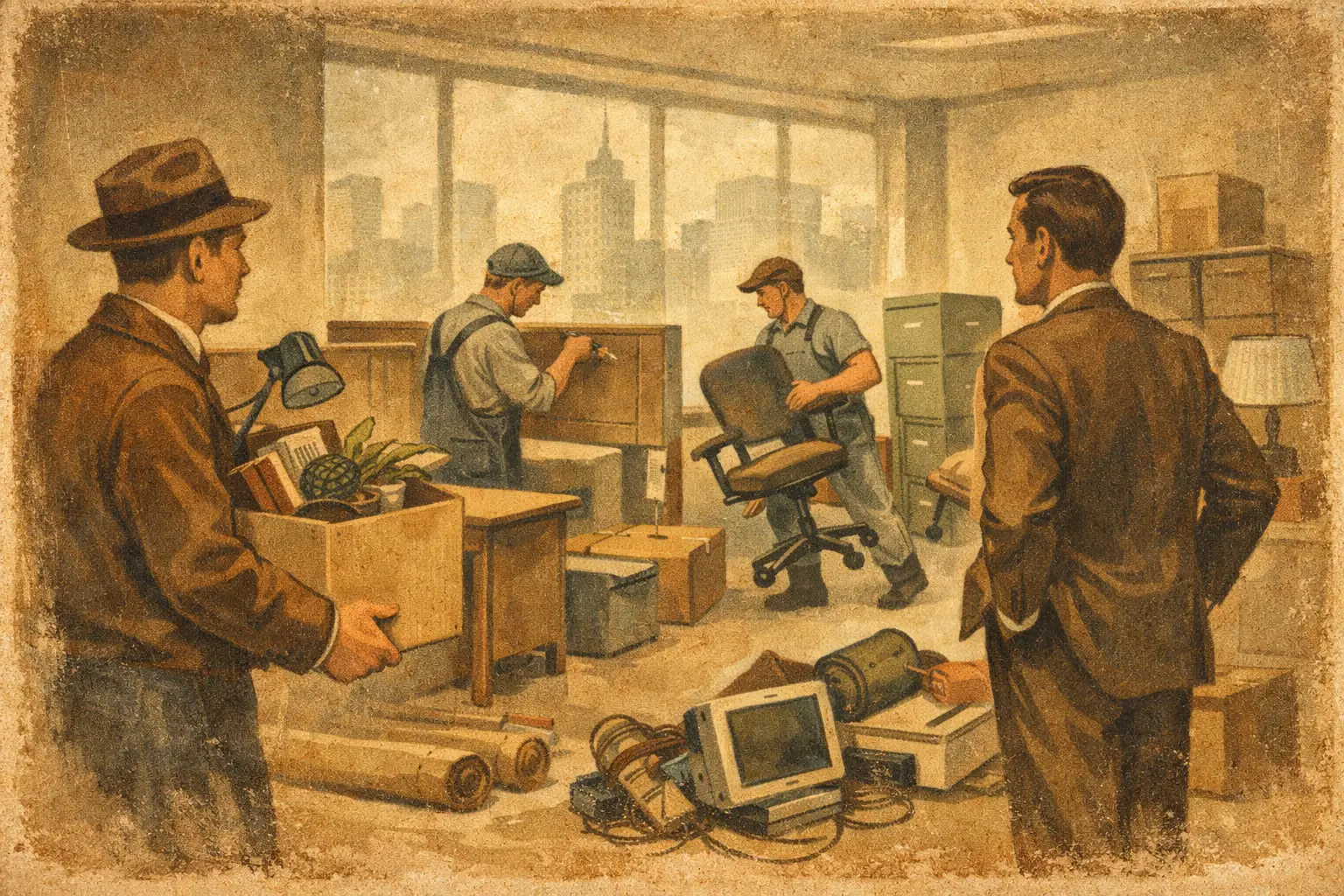
Office Decommissioning Services That Keep You Compliant
Office decommissioning services that manage clearance, IT assets, furniture, waste and handback, helping your business stay compliant and on schedule.
Call us on 0208 3517 101
 ISO 9001 & 14001
Certified
ISO 9001 & 14001
Certified 4.9
Trustpilot
4.9
Trustpilot 5.0
Google Reviews
5.0
Google Reviews 195+
Trees Planted
195+
Trees Planted 25+ Years
Experience
25+ Years
ExperienceA lease end date can arrive faster than expected. Once staff, furniture and IT equipment begin leaving the building, the remaining work is often more complex than the move itself. Professional office decommissioning services give businesses a controlled way to clear a workplace, protect data, manage waste and meet landlord handback requirements without placing the burden on an already stretched internal team.
For office managers, facilities teams and project leads, decommissioning is not simply about emptying a floor. It is a planned commercial process with compliance, security, environmental and operational consequences. A poorly managed exit can result in delayed handover, avoidable dilapidation costs, unaccounted-for IT assets and confidential information left at risk.
What office decommissioning involves
Office decommissioning is the structured closure, clearance and return of a commercial workspace. The scope depends on the lease, the building, the amount of equipment involved and whether the organisation is relocating, consolidating or closing a site altogether.
A complete service usually begins with a site survey and inventory. This identifies what must move to a new location, what can be stored, what can be reused or donated, and what requires compliant disposal. It also establishes practical constraints, including access arrangements, lift capacity, loading restrictions, security procedures and the building’s permitted working hours.
The work can then include furniture dismantling, removal of redundant workstations, packing and transporting retained items, secure IT asset handling, recycling, waste management and final clearance. Where required, it may also cover the removal of branding, internal signage, partitioning and other tenant-installed items before handback.
The objective is straightforward: leave the premises clear, safe and ready for the next agreed stage, while maintaining a complete record of assets and waste streams.
Why a clearance-only approach creates risk
Hiring a general clearance provider may appear cheaper at first. However, it can create gaps between the teams responsible for moving assets, handling data-bearing equipment, disposing of waste and coordinating with the landlord. Those gaps are where costs and delays tend to develop.
Take redundant laptops, servers and hard drives. They cannot be treated as ordinary office waste. Devices may contain personal data, commercial records, passwords or client information. The same applies to printed files, archived documents, labelled storage media and even multifunction printers with internal memory.
Furniture presents a different challenge. Desks, chairs, filing cabinets and meeting-room equipment may still have a useful second life. Reuse, resale or donation can be preferable to disposal, but only when items are assessed, collected and documented properly. Damaged or unsuitable items need to be segregated so that recycling and disposal routes are used responsibly.
A managed approach brings these activities into one plan. It gives the project team clear accountability, reduces duplicate vehicle movements and helps prevent valuable assets from being cleared by mistake.
A practical decommissioning plan starts with the lease
The lease and landlord’s schedule of dilapidations should guide the scope from the outset. Some tenants must return the office to its original condition, while others have agreed a different handback standard. Assumptions are expensive at this stage.
Review the documents early with the landlord or managing agent. Confirm whether tenant alterations, cabling, signage, fixtures, floor coverings or partitions must be removed. Establish how condition will be assessed, whether photographic evidence is expected and when the final inspection will take place.
A project manager should then turn those requirements into a programme. This means sequencing work around the move-out date, arranging building access, booking lifts and loading bays, and allowing time for unexpected findings. If the building has strict out-of-hours rules, those constraints need to be reflected in labour and transport planning from day one.
It also helps to nominate one internal decision-maker for disposal and reuse approvals. Without this, teams can lose time debating whether individual items should move, be stored or be cleared once operatives are already on site.
Managing IT assets and confidential information
IT decommissioning needs a clear chain of custody. Every device should be identified before it leaves the workplace, with records showing whether it is being relocated, stored, returned to a supplier, reused or disposed of.
For servers and network equipment, the priority is continuity. Shutdown and disconnection should be planned with the IT team, particularly where systems support remote users, telephony, security or business-critical applications. Equipment must be packed in appropriate protective materials, labelled clearly and transported securely.
For end-user devices, data protection is equally important. A compliant process should separate equipment awaiting data wiping from equipment cleared for reuse or recycling. Businesses should retain documentation demonstrating what happened to each asset, especially where regulated data, financial records or customer information may be involved.
Paper records deserve the same discipline. Locked console bins, secure document destruction and controlled collection arrangements are preferable to placing files in ordinary waste containers. The cost of handling confidential material correctly is modest compared with the consequences of a data breach.
Responsible furniture and waste management
Decommissioning can generate significant volumes of material, particularly after a long lease or an office redesign. The most responsible option is not always the fastest one, so decisions should balance programme deadlines with environmental objectives.
Items in good condition may be suitable for reuse within the organisation, storage for a future project, resale or donation. Furniture that cannot be reused may still contain recyclable materials such as metal, timber and plastic. Separating these streams improves the likelihood of recovery and reduces unnecessary landfill.
Waste documentation matters. Your provider should be able to explain how waste is categorised, where it is taken and how collections are recorded. This is particularly relevant for electrical equipment, batteries, fluorescent tubes and other materials requiring specialist handling.
SolutionsX combines commercial clearance, storage, relocation logistics and responsible disposal planning, allowing businesses to manage retained assets and redundant items through one accountable project team.
Keeping the final days under control
The last week of an office exit is when a good plan is tested. Staff may still be working, the new office may be receiving deliveries, and the landlord may request access for inspections. Clear communication prevents the decommissioning programme from disrupting work that is still underway.
A phased approach often works best. Non-essential furniture, archive material and surplus stock can leave first. IT equipment and operational workstations can be scheduled later, with contingency for teams that need to remain active until the final day. Shared areas, kitchens and meeting rooms are usually cleared once staff have moved to alternative arrangements.
Before the final handback, carry out a joint walkthrough against the agreed scope. Check cupboards, comms rooms, storage areas, under-desk pedestals and ceiling or floor voids where relevant. Photograph the cleared space and retain collection records, asset lists and disposal certificates in the project file.
Questions to ask before appointing a provider
The right provider should be able to describe the process in practical terms, not just quote a clearance rate. Ask who will manage the project, how IT assets are tracked, what environmental documentation is provided and how access restrictions will be handled.
You should also ask whether the provider can coordinate removals, storage and installation at the destination site. A single specialist team can reduce handovers and simplify communication, particularly where a relocation and lease exit are happening at the same time.
Price remains important, but a quote should show what is included. Labour, vehicles, packing materials, dismantling, disposal, storage, out-of-hours work and specialist waste handling can all affect the final cost. A detailed scope makes comparisons fairer and reduces the chance of late variations.
Plan the handback as carefully as the move
The best office decommissioning projects do not feel rushed because decisions are made before the final week. Start with the lease obligations, build an asset and waste inventory, involve IT early and assign responsibility for every item that leaves the building. That preparation gives your team the space to focus on the next workplace, rather than resolving avoidable issues at the old one.
A well-managed handback protects more than a deposit or a deadline. It protects business information, environmental commitments and the confidence of everyone relying on the move to be completed properly.

Get Your Free Quote Today
Fill out the form below and our team will respond within 2 hours
Reach out and we’ll
get back to you shortly.


12 Jenner Avenue Acton,
W3 6EQ London

Saturday: 9:00am – 2:00pm
Sunday: Closed