 0208 3517 101

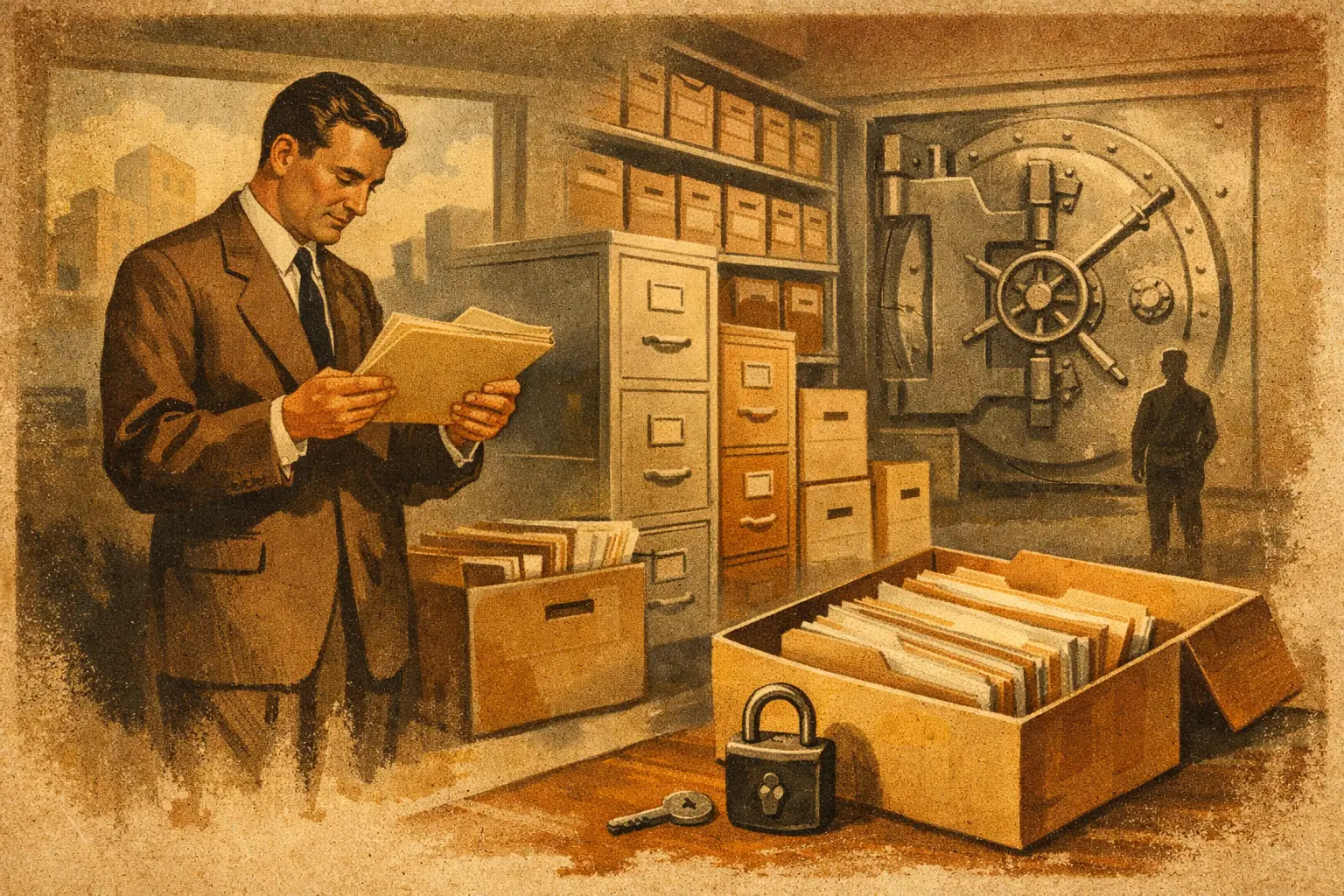
Business Archive Storage Without the Risk
Business archive storage that protects records, frees valuable office space and keeps files accessible, compliant and ready whenever your team needs them.
Call us on 0208 3517 101
 ISO 9001 & 14001
Certified
 4.9
Trustpilot
 5.0
Google Reviews
 195+
Trees Planted
 25+ Years
Experience
A crowded stationery cupboard is rarely just a space problem. It can contain personnel files, signed contracts, tax records, client correspondence and project documentation that must be retained, found quickly and destroyed at the right time. Effective business archive storage turns those records from an unmanaged liability into a controlled business asset.
For office managers, facilities teams and operations leaders, the objective is straightforward: protect confidential information, recover usable workspace and keep records available without adding work for internal staff. The right approach depends on what you hold, how often it is needed and the obligations attached to it.
What business archive storage should deliver
Archive storage is not simply putting boxes in a warehouse. A professional arrangement gives each box or file a clear identity, a recorded location and an accountable chain of custody from collection to retrieval or authorised destruction.
That matters when a member of the HR team needs a historic personnel record, finance requires supporting documents for an audit, or legal advisers issue a request for a specific contract. Staff should not be searching through unlabelled cartons in a basement or relying on one person’s memory of where a document was left.
A well-managed archive service should provide secure collection, indexed inventory control, protected storage conditions, documented retrieval procedures and confidential destruction when retention periods end. It should also support your wider workplace strategy. Moving inactive records off site can release valuable floor space for meeting rooms, workstations or business growth.
Start with a records audit, not a storage quote
Before deciding how much storage you need, establish what is actually in your archive. Businesses often pay to store duplicate documents, expired records and boxes with no meaningful description. Equally, they may dispose of information too early because retention responsibilities are not clear.
Create categories that reflect how your business operates, such as finance, HR, legal, client, property, project and operational records. Record the owner of each category, the retention period, confidentiality level and whether the material is likely to be requested. This does not need to become an overly complicated exercise. The aim is to make defensible decisions about what to retain, digitise, transfer or destroy.
Retention rules vary by document type, sector and circumstance. Tax records, employment information, health and safety documents, contracts and records subject to a legal hold may all require different treatment. Where the position is unclear, take advice from your legal, compliance or data protection team before authorising destruction.
Secure business archive storage needs a clear chain of custody
The point at which records leave your office is often where control is lost. Boxes are loaded during a busy clear-out, labels are vague and no one can later confirm what was collected. This creates avoidable risk, particularly where personal data or commercially sensitive information is involved.
A controlled collection process starts with suitable archive cartons, consistent labelling and a manifest that links every box to its contents category and retention instruction. Barcoding is particularly useful for larger archives because it replaces guesswork with a searchable record of each item’s location.
Security should extend beyond the storage room. Ask how collection staff are managed, how consignments are tracked in transit, who can authorise retrievals and what happens if an item is damaged or cannot be located. You should also understand the site’s access controls, monitoring arrangements, fire protection and environmental conditions.
For sensitive information, compliance with UK data protection requirements is part of the operational process, not an afterthought. Your storage provider should be able to explain its procedures clearly, including how it handles personal data, access requests and secure destruction. Relevant quality and environmental management credentials can provide additional assurance, but they do not replace a detailed review of the service itself.
Business archive storage during an office move
Office relocation is an ideal time to deal with accumulated records. Rather than moving every archive box from one office to another, separate active files from dormant material during the planning phase. This reduces moving volumes, lowers pressure on the new office layout and prevents archive cupboards becoming the default destination for anything without an owner.
The work needs to be scheduled carefully. Records that remain active during the move may need priority access or staged transfer, while inactive material can be collected earlier. A dedicated project manager can coordinate this alongside packing, furniture moves, IT relocation and clearance so that archive decisions do not delay the wider programme.
This is also a sensible point to identify documents for approved confidential destruction. Destruction should be documented, with a certificate or auditable record where required. General waste disposal is not an acceptable substitute for the secure destruction of confidential business records.
SolutionsX can integrate secure archive storage into a wider commercial relocation plan, giving businesses one accountable team for packing, transfer, storage, workplace setup and clearance.
Physical storage, scanning or a hybrid approach?
Scanning is valuable, but it is not automatically the answer for every archive. Digitising high-use files can speed up access, support remote teams and reduce the need to retrieve physical documents. It can also make sense when records are compact, standardised and likely to be searched regularly.
However, large scanning projects require preparation, quality checks, indexing rules and appropriate access permissions. Poorly named digital files can be just as difficult to find as poorly labelled boxes. Some original documents may also need to be retained due to legal, contractual or evidential requirements.
A hybrid model is often the most practical option. Keep regularly referenced records in a secure digital system, store physical originals that must be preserved, and apply scheduled destruction to material that has reached the end of its retention period. The right balance depends on retrieval frequency, document type, storage costs and the effort required to scan accurately.
Set retrieval standards before records are needed
A storage arrangement only proves its value when an urgent request arrives. Agree retrieval procedures at the outset, including who can request a box, how requests are approved, expected delivery times and whether scanned copies can be supplied where appropriate.
For many organisations, standard retrieval is sufficient. Others, such as businesses with frequent audit activity, multiple sites or active casework, may need faster turnaround and a defined process for regular file rotation. Be realistic about the service level you require. Paying for an emergency response you rarely use may not be cost-effective, while choosing the lowest-cost option can create disruption when access is genuinely time-critical.
Your archive register should be reviewed periodically. This helps prevent boxes remaining in storage indefinitely simply because no one has revisited their status. Annual reviews are often enough for stable archives, though regulated or rapidly changing businesses may need more frequent checks.
Questions to ask a storage provider
Before appointing a provider, establish whether its service can meet your operational and compliance needs. Ask how boxes are identified and tracked, what security controls protect the site, how quickly records can be retrieved and how destruction is authorised and evidenced.
You should also confirm pricing structure. Storage charges may be affected by box quantity, collection, retrieval, return delivery, scanning and destruction. Clear pricing makes it easier to compare proposals and avoids a low initial rate becoming expensive once records need to move.
Finally, consider accountability. If archive storage forms part of an office move, working with a provider that can coordinate both services reduces handovers and gives your team a single point of contact when plans change.
A controlled archive supports a controlled workplace
The best archive is not the one with the most boxes stored cheaply. It is the one where every retained record has a reason to exist, a known location, appropriate protection and a planned end date. Put that control in place before your next office move, audit or urgent records request, and your archive will stop consuming space and management time.

Get Your Free Quote Today
Fill out the form below and our team will respond within 2 hours
Reach out and we’ll
get back to you shortly.


12 Jenner Avenue Acton,
W3 6EQ London

Saturday: 9:00am – 2:00pm
Sunday: Closed